 Elina Tagara
After market success with Sales Cloud, Salesforce launched Service Cloud. This customer service solution enables organisations to streamline all support requests and provide unified support across multiple customer service touchpoints: email, text, phone, chat and social media.
The solution gives organisations a full 360-degree view of all customer service interactions and links back to their data and profile on Sales Cloud. Since launch, this solution has been hugely successful; in recent years it has been Salesforce’s largest revenue generator, earning almost $7 billion annually.
And the great news for you? Businesses generally see a cost saving of 27% when they implement Service Cloud.
Let’s dive into what Salesforce Service Cloud is and how it can help your customer service team…
What is Salesforce Service Cloud?
Service Cloud is a customer relationship management (CRM) platform designed for service teams to manage their customer support processes and tickets. The solution enables service teams to manage cases, share knowledge and solve incidents collaboratively through an AI-supported workspace. Service Cloud allows you to integrate multiple channels, including phone, email, messaging, chat, and social media, to streamline customer interactions, boost productivity and increase customer satisfaction.
You can integrate multiple channels, including phone, email, messaging, chat, and social media, to streamline customer interactions, boost productivity and increase customer satisfaction.
Built natively within the same platform as Sales Cloud and other Salesforce solutions, Service Cloud doesn’t require any additional integration. From initial set-up, organisations get a 360-degree view of their sales, operations, marketing, data and overall business health – all in one place.
What is Salesforce Service Cloud used for?
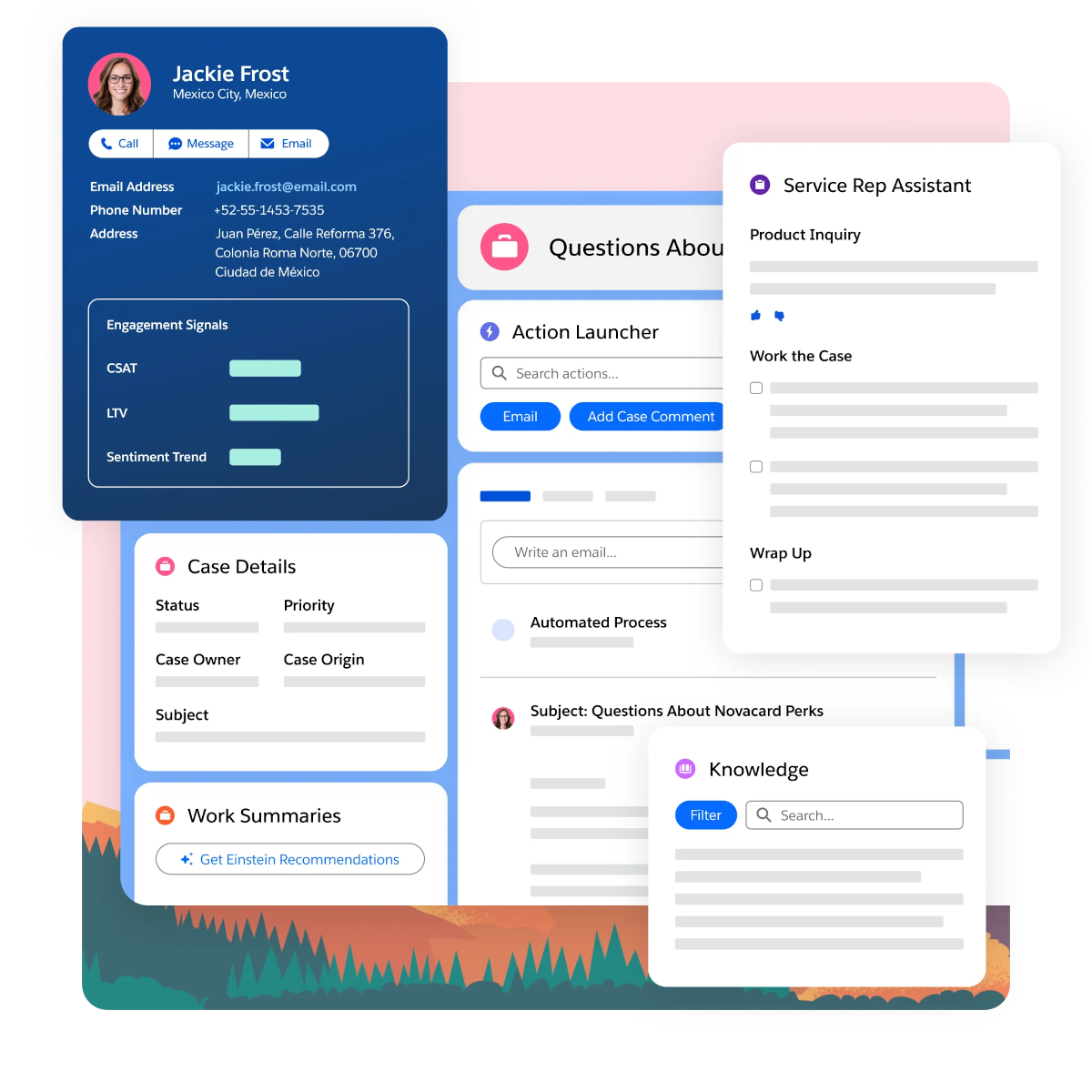
Salesforce Service Cloud is used for all different types of interactions with customers, from support tickets and knowledge management to incident reports and analysis. The solution is designed to give service teams a unified view of all customer requests across multiple channels, and then allocate support for efficient follow-up.
Here are a few examples of service team challenges Salesforce Service Cloud is designed to tackle:
1. Slow response times and high customer expectations
Customers expect an immediate response, and delays can lead to frustration and lost business.
Service Cloud automates case routing and uses AI-powered chatbots to provide instant responses, reducing wait times and ensuring customers get immediate assistance.
2. Fragmented customer data
Customers reach out through a variety of channels (phone, email, WhatsApp). When this information and data are scattered across all these different platforms, service agents cannot easily see a full interaction history.
Service Cloud provides a unified 360-degree view of customer interactions, consolidating all data in one platform for personalised, informed support.
3. Inconsistent support across channels
If customers do reach out via different channels, they often receive an inconsistent experience or response, channel to channel.
Service Cloud’s omnichannel routing directs customer inquiries to the right agent automatically, regardless of channel, ensuring consistent service quality.
4. Inefficient case management
When there are high volumes of customer inquiries, it’s difficult to track them manually, leading to lost or delayed responses.
Service Cloud supports service teams with intelligent case management with AI-driven automation that categorises, prioritises, and routes cases automatically, reducing manual effort and time.
5. Limited self-service options
If the issue has a simple fix, customers often prefer resolving the issue independently; however, many businesses do not have adequate knowledge bases.
Service Cloud offers comprehensive self-service portals with AI-powered knowledge bases that enable customers to find solutions independently and therefore reduce support team workload.
What are the key features of Salesforce Service Cloud?
Case Management & Dashboard
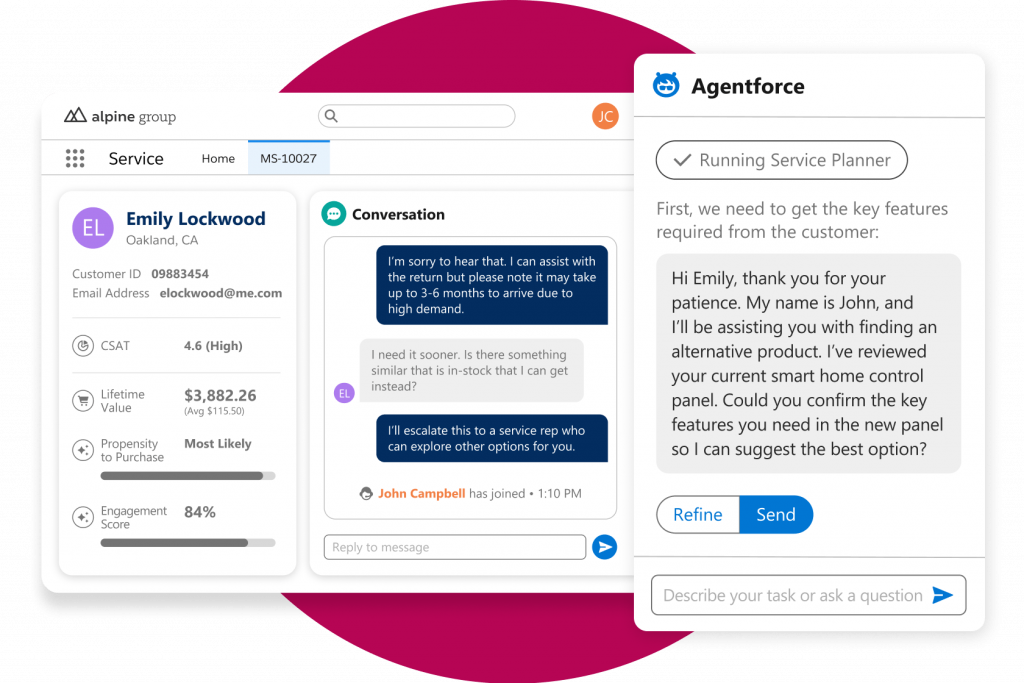
Through one unified dashboard, customer service teams can easily manage all interactions. Automatically assign requests and tickets from any channel to the right service agent based on availability and expertise. Integrate AI to analyse requests and generate replies based on your knowledge base, for service agents to review and quickly send out to customers.
Knowledge Base
Bring together all information and knowledge about your business into a single knowledge base, allowing customers to access it independently and reducing service support tickets for easy solutions. Use the knowledge to train your AI integration. Offer customers recommended articles and resources, or integrate AI-generated answers into your workflow or chat service to help speed up conversations with customers.
Customer Service Incident Management
Detect and resolve any disruptions quickly with proven workflows. Bring together experts across your organisation to execute a work plan, the necessary steps to fix the issue and ensure the incident does not recur. Use broadcast communications to keep customers in the loop, with real-time updates and notifications. Keep service reps and internal stakeholders up to date too, via Service console or Slack.
Direct Slack Integration
Improve collaboration by directly accessing Slack chats in the service cloud console. Bring together experts to kick off a swarm channel for incident resolution. Integrate Slack into your service workflows to contact and connect with the right team members and eliminate manual tasks. Review swarming metrics via out-of-the-box reports and dashboards.
Works hand in hand with Field Service
For organisations that have field-based teams, Service Cloud and Field Service can work together. A case in Service Cloud can automatically trigger a field service work order, dispatching an engineer with the right information and tools for the job. On the back end, service agents get full visibility of support tickets, requests, asset history and engineer locations. The result? Customers get a seamless service and experience.
Salesforce Service Cloud in action
Complete digitalisation of the customer service experience
Gravity, an entertainment and activity destination, offers high-energy experiences at its sites nationwide. However, despite a strong customer experience on-site, the team lacked a complete solution to deliver the same experience online for customer service and enquiries. With disparate platforms, there was no accountability for following up, the call centre was overworked, and the internal ticketing platform was outdated.
We worked together to completely digitise the customer service experience, bringing together multiple solutions—BookNow, Service Cloud, and Digital Engagement—that now give the team a holistic view of all cases and a direct link to customer bookings. With the integration of a live agent, repetitive questions and requests can be handled quickly, dramatically reducing the number of calls.
Replacing a costly custom tool with a future-proof Service Cloud solution
Suntory, the global drinks manufacturer, had previously built a custom customer service tool that for a long time had served them well. However, with regular Salesforce feature releases, keeping it up to date and aligned with Sales Cloud had become expensive and difficult.
We replaced the legacy tool with a full Service Cloud implementation. This involved integrating Coheris and building out functionality for letter generation, auto case closure, knowledge base management, GDPR data handling and voucher tracking. Suntory now has a platform that keeps pace with Salesforce’s updates automatically, without the overhead of maintaining something bespoke.
Centralising a fast-growing business on one connected platform
Leach’s, a rapidly growing scaffolding company, was feeling the strain of its own success. Customer data was scattered, support cases were hard to track and double data entry was slowing the team down. Without a centralised hub, new hires were finding it difficult to get up to speed quickly.
We brought together Service Cloud for case management and customer communications, and integrated Sales Cloud with their OrderWise system to centralise order data in one place. Leads from multiple sources are now managed efficiently within Salesforce, and the streamlined setup means new team members can get up and running much more efficiently.
Looking to improve your sales processes and drive revenue growth? Choose Salesforce Service Cloud and partner with Simpala for expert implementation and support.